About
I am an artist. My main instrument is Unreal Engine, and my second is Houdini — together they cover everything I do: procedural geometry in Houdini, and the finished, lit, playable world in Unreal. More than five years in Unreal Engine — since version 4.26 — carrying projects through every release, including the move from UE4 to UE5.
I do not write code by hand, and I never studied a programming language. How I work instead is described in the next section, and it is the reason a one-person studio can now ship a finished product: in four months I released a complete, playable game on Steam — with its own website, its own championship system and a live scoring leaderboard — and then built a procedural building generator for Unreal Engine from scratch and released it for free.
I am comfortable across the whole pipeline: blocking out a level, lighting it with Lumen and Nanite, retargeting animation, mixing audio in 5.1, designing the interface, wiring up gameplay, packaging the build, and putting it in front of players.
How I Work
An artist directing an AI programmer
My programmer is an artificial intelligence — Claude Code, by Anthropic. I define the task, take every design and technical decision, review what comes back and own the result; the assistant writes the code.
This is not a demo or an experiment. It is how real, shipped products were made:
- A full game, from first prototype to a Steam release in four months — gameplay, enemies, weapons, interface, audio, settings, save system, packaging.
- A working competitive system: the score is calculated from the player's actual run — accuracy, speed, kills, headshots, damage, waves survived — and feeds three separate championship categories with a leaderboard shared between the game and the website.
- The game's website, written from scratch in vanilla HTML/CSS/JS, including the live leaderboard and a full English / 简体中文 localization.
- A procedural building generator built from nothing in Houdini and Unreal, released free to the community with a complete tutorial series.
I say this openly because it is the point, not a caveat. The engine does not decide what a level should feel like, when the lighting is wrong, or why a mechanic is not fun. Directing a project — stating the task precisely, reading the result critically, and refusing to let the quality slip — is the work, and that is what I bring to it.
Skills
Primary: Unreal Engine + Houdini
Unreal Engine 5 — level assembly, Lumen and Nanite lighting, Blueprints, Sequencer, UMG interfaces, gameplay logic, animation blueprints and state machines, MetaHuman characters, audio, cooking and packaging, Steam integration (leaderboards, stats, achievements), in-game localization.
Houdini — procedural modelling, authoring HDAs, Houdini Engine for Unreal, KineFX animation retargeting, procedural cities built for real-time use.
Characters & Animation
- MetaHuman
- Character Creator
- iClone
- Mixamo → KineFX → Unreal retargeting
Lighting & Show Control
- MagicQ PC (ChamSys) — a real lighting console bridged live into Unreal Engine
- Moving heads, beams and colour driven in real time, cued to the music
- Directly applicable to virtual production
Audio
- Adobe Audition
- Stereo → Dolby Surround 5.1 for real-time engines
- In-engine audio: ambience, music, mix
2D & Video
- Photoshop, Topaz Photo AI
- After Effects, Premiere Pro
- Trailer and tutorial production
Publishing
- Steam store page and build pipeline
- Websites in vanilla HTML/CSS/JS
- EN / 简体中文 localization
- YouTube channel and tutorial series
Working With AI
- Claude Code (Anthropic) as a development partner
- Task definition, code review, quality control
- Shipped products, not experiments
Games
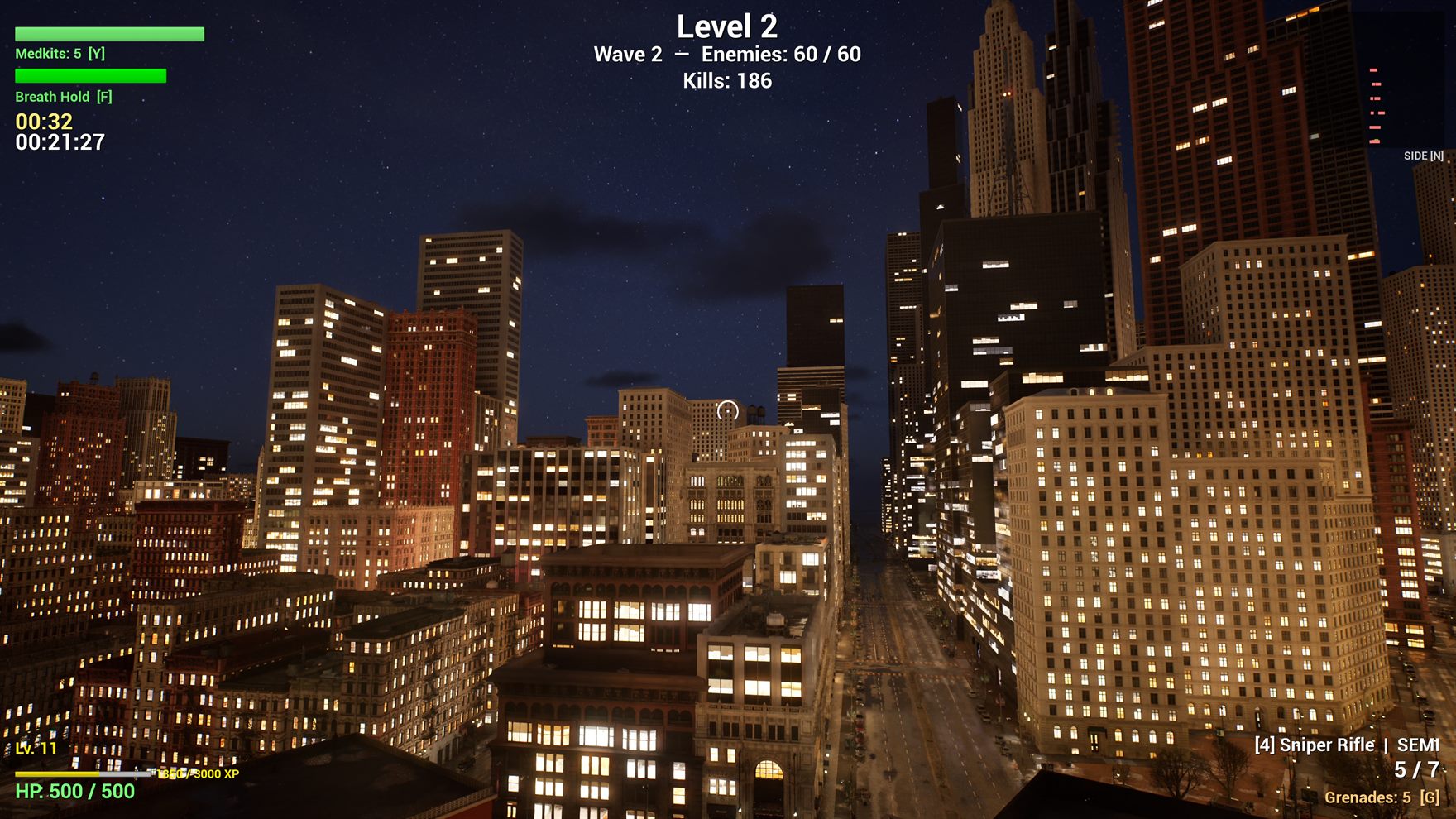
Sniper Game Released on Steam
A sniper championship played across two buildings and scored in three separate categories — Accuracy, Speed and Universal. Every run is measured in detail: waves survived, shots fired, hit rate, kills, headshots, damage, time. Those numbers feed a world leaderboard that the game and the website share.
Everything in it is mine: gameplay, level, characters, animation, interface, audio, settings, the Steam integration, the store page and the site.
- Steam: https://store.steampowered.com/app/4831000/Sniper_Game/
- Website, built by me (EN / 中文): https://sniper-game.com
Captured in the shipped build — HUD included, nothing retouched.
Sniper Game 2 In development
The next game. The city is assembled from buildings made by my own procedural generator, and they are modelled all the way through — floor plates, staircases, a lift shaft and its cabin, a glass roof, an atrium — so a sniper position is a place you walk into, not a facade you look at. Interiors are being detailed floor by floor.
Straight from the editor viewport, unretouched — work in progress, shown as it stands.
Tools
Free City Generator — real city districts in Unreal Engine 5.8
Outline a district of any real city on a map and get a living City Sample city in Unreal: the real street layout from OpenStreetMap, buildings from Epic’s library sized to the real footprints and heights, terrain from elevation data, freeways with on- and off-ramps — several freeways per district, crossing one deck over another — and City Sample’s traffic and pedestrian crowds running on top. The generator feeds Epic’s own City Sample tools in Houdini with real map data instead of hand-drawn curves, from a few buttons and no sliders. Tested on San Francisco, Barcelona, Los Angeles and Miami. Free and open source under the MIT licence, including for commercial work; the code was written by an AI programmer under my direction.
- Source code on GitHub: https://github.com/AlexKorotkin-creator/CityGenerator
- Epic Developer Community: https://dev.epicgames.com/community/learning/tutorials/bL2rZ/free-city-generator-real-city-districts-in-unreal-engine-5-8-2-houdini-22-epic-city-sample
- Full tutorial on YouTube: https://youtu.be/oEqk84qlo1A
Free Building Generator for Houdini + Unreal Engine 5.8
A procedural building generator built as a Houdini digital asset and driven from Unreal: draw a spline and you get a building with floors, walls, columns, staircases, a lift shaft and working collision — ready to bake into a Blueprint and walk through. It is free and open source, including for commercial work, and what you generate with it is yours. Two versions: v2 is much faster, v1 lets you save and carry on another day.
- Source code on GitHub: https://github.com/AlexKorotkin-creator/BuildingGenerator
- Epic Developer Community: https://dev.epicgames.com/community/learning/tutorials/8KnB/free-houdini-21-0-753-unreal-engine-5-8-building-generator-for-beginners-and-advanced-users
- Tutorial playlist: https://www.youtube.com/playlist?list=PLLvlwfuv1pNA
These are unedited generator output. The detailed building in Sniper Game 2 above started as one of these — same asset, then dressed by hand.
Tutorials
I teach the pipelines I actually use in production — on my own YouTube channel and in Epic’s learning library, the Epic Developer Community.
Published on Epic Developer Community
- Free City Generator — real city districts in Unreal Engine 5.8.2 + Houdini 22: https://dev.epicgames.com/community/learning/tutorials/bL2rZ/free-city-generator-real-city-districts-in-unreal-engine-5-8-2-houdini-22-epic-city-sample
- Part 5 — upgraded Building Generator, Houdini 21.0.753 + Unreal Engine 5.8.2: https://dev.epicgames.com/community/learning/tutorials/9mXME/part-5-upgrade-building-generator-houdini-21-0-753-unreal-engine-5-8-2
- Free Building Generator for beginners and advanced users: https://dev.epicgames.com/community/learning/tutorials/8KnB/free-houdini-21-0-753-unreal-engine-5-8-building-generator-for-beginners-and-advanced-users
- All my tutorials there: https://dev.epicgames.com/community/profile/BK0v/KorotkinAlexande
Free City Generator — real city districts in Unreal Engine 5.8.2 + Houdini 22
From an empty folder to a district of a real city in Unreal with traffic and crowds: drawing the district on a map, Houdini 22 and Epic’s City Sample tools, Rule Processor, ZoneGraph, traffic, pedestrians and live trees — one 52-minute walkthrough.
- YouTube: https://youtu.be/oEqk84qlo1A
Free Houdini + Unreal Engine 5.8 Building Generator
- Full playlist: https://www.youtube.com/playlist?list=PLLvlwfuv1pNA
- Part 1 — the generator: https://youtu.be/JiVEJJDeOF0
- Part 2 — building the second block: https://youtu.be/MZruxKioG4w
- Part 3 — the glass roof: https://youtu.be/FuXDrIgclpo
- Part 4 — background music in Dolby Surround 5.1: https://youtu.be/9aXW7_WrmwE
- Part 5 — the upgraded generator, from City Sample blocks to a baked Blueprint: https://youtu.be/lHj8kQujC0w
Build your own City Sample city in Houdini — with traffic and crowds
Built on Epic’s own City Sample documentation and worked out end to end: generating the city in Houdini, exporting it into Unreal, and setting up moving traffic and pedestrian crowds — the part most city workflows leave out.
Virtual Production & Music Videos
A real lighting console, programmed and run live into Unreal Engine — the same discipline that drives an LED volume or a live show, applied to a rendered stage.
Fan clip — Sia, “Unstoppable”
The entire stage rig is programmed in MagicQ PC and driven live into Unreal: fixture movement, beams and colour cued to the track.
Frames from the finished clip.
D.A. — “In Neoton City”
The same live lighting pipeline, and this time the whole city around the performance was built for the shot — a full urban environment populated with KitBash3D Cargo buildings that I brought in, adapted and laid out myself. This was before my own building generator existed.
The stage lighting is mine, cued live from the console; the surrounding buildings are KitBash3D Cargo assets that I laid out and lit.
City showcase — a full city assembled in Unreal
A walkthrough of a complete city I assembled in Unreal, made before my own City Generator above. The city generator used here I bought from another author and worked to his tutorial; the buildings are KitBash3D Cargo assets, chosen, adapted and laid out by me. Assembling a city this size — layout, road network, building placement, materials and lighting — and keeping it running in real time is the work I am showing here.
Interactive Experiences
Interactive virtual exhibition for a music artist
A first-person application the visitor walks through: a lobby presenting the artist's biography, interactive stands where a pointing cursor opens information widgets on click, and halls lined with screen-posters — click one and the music video plays on it. The whole space is mixed in 5.1 surround.
Architecture, lighting, interaction, interface and audio — all by one person.
Where this goes next. The same foundation supports a customisable avatar, live chat between visitors and full multiplayer — a virtual venue rather than a walkthrough. This is a direction I want to keep working in.
Contact
I come with a studio that is already built
I work remote-first, from a production setup that took years to get right.
Two workstations, four displays. A 56-inch panel for the engine, a second large display beside it, and two more below. Unreal or Houdini runs on the main machine while reference, documentation or a training video plays on the other — with its own keyboard in reach, so stopping and restarting a video is one keypress, not a hunt with the mouse across a cluttered desktop. It sounds like a small thing; across a working day it is the difference between staying in flow and breaking it every few minutes.
The machine behind it. Heavy work does not have to be scheduled around the hardware here — Houdini cooks, Lumen and Nanite scenes, 4K video renders and full engine rebuilds run while I keep working on something else:
- CPU: AMD Ryzen Threadripper 3970X — 32 cores / 64 threads
- GPU: NVIDIA GeForce RTX 4090
- RAM: 128 GB DDR4-3600
- Storage: 2 TB NVMe + 4 TB SSD + 8 TB HDD
Every licence is already mine and already paid for: Houdini, the full Adobe suite (Premiere Pro, After Effects, Audition, Photoshop), Claude Code, and the asset libraries I have built up over the years. Nothing has to be purchased, installed, approved or waited on. No onboarding week — I start at full speed on day one, on hardware tuned for exactly this work.
Audio is monitored properly — a real 5.1 speaker layout with the rear channels on the wall behind me, not a pair of headphones. That is the difference between guessing at a surround mix and delivering one.
This is not theory: a released Steam game, a public tool used by other developers and a full tutorial series were all made from here, solo.

Fully remote, and set up for it. Kickoffs, reviews and dailies run over video from this desk, with the engine on one screen and the call on another — so a review is conducted live in the project rather than described afterwards. It is the daily production work that is faster, quieter and better equipped where it already runs.
Open to work — remote worldwide. Based in Israel (UTC+2/+3), with comfortable overlap across Europe and flexible hours for other time zones.
- Email: ripper120767@gmail.com
- Sniper Game on Steam: https://store.steampowered.com/app/4831000/Sniper_Game/
- Game website: https://sniper-game.com
- YouTube tutorials: https://www.youtube.com/playlist?list=PLLvlwfuv1pNA
- Epic Developer Community: https://dev.epicgames.com/community/profile/BK0v/KorotkinAlexande
- GitHub: https://github.com/AlexKorotkin-creator